
Esther Perbandt | Zero Point: Where Fashion, Space, and Self-Perception Converge
Esther Perbandt, the Berlin-based designer, reflects on fashion as performance, black as a conceptual space, and the delicate tension between artistic freedom and economic reality.
Esther Perbandt does not draw strict lines between fashion, art, installation, and performance. Instead, she inhabits the tension between disciplines, between freedom and responsibility, between control and disruption. For more than 22 years, she has built a universe shaped by structure, black as a zero point, and an uncompromising exploration of protection, autonomy, and emotional depth. In this conversation with Luxiders Magazine, she speaks about site-specificity, empowerment beyond theory, and why the future of fashion lies in coexistence rather than opposition.
“I live in the tension between freedom and reality, and that tension is exactly where my work exists.”


Your fashion exists at the intersection of art, performance, music, and space. How do you personally define the boundary, or lack of boundary, between fashion and art today?
In my dream world, there would be no boundaries at all between fashion, art, performance, music, or space. I would simply float and move freely through all of these disciplines. The only real limitation in that world would be time, because, unfortunately, there are still only 24 hours in a day.
In reality, however, I am constantly confronted with another kind of boundary: practicality. I always have to do a reality check with everything I create. Is it wearable? Is it sellable? Can I make a living from it? Are the production costs realistic? These questions are unavoidable when fashion is also your everyday bread.
So the boundary between fashion and art is not something I consciously draw, rather, it’s something that emerges through responsibility. Whenever I allow myself to move too far away from what sustains the business, I can feel it immediately: a lack of attention, a lack of grounding. That doesn’t mean I value those artistic explorations any less; it simply means they need to find the right moment and context.
That I personally don’t see strict boundaries is a very subjective point of view. I know many people draw much clearer lines between fashion and art. For me, they naturally overlap; I live in the tension between freedom and reality, and that tension is exactly where my work exists.
Your shows function as total artworks rather than conventional runway presentations. What does the performative format allow you to communicate that a traditional fashion show cannot?
Creating a new collection involves an enormous amount of passion and invisible labor: loving craftsmanship, sleepless nights, dreaming, rejecting ideas, changing them again, refining, improving, feeling disappointed, getting back up, and starting over. For me, that kind of process deserves a form of presentation that truly does it justice.
As much as I love large runway shows, and they can be addictive, they offer only a fleeting moment of perception. A model walks past, turns, walks back. Seconds later, the look is gone. Often, by the time the audience goes to bed, they no longer remember what they actually saw.
An installation or performative presentation creates a completely different kind of encounter. It allows viewers to stay. To pause. To stand in front of a look that speaks to them and study every detail, every seam, every layer of work that went into it. That depth of attention is something a conventional fashion show rarely allows.
But my ambition goes even further. I always ask myself how a presentation can communicate more than clothing alone, how it can evoke a feeling, open a space for imagination, invite people to dream, or even tell stories without explicitly narrating one. For me, performance and installation are tools to translate the emotional and mental world behind a collection into something physically experienceable.
In your work, fashion becomes an experience that questions the viewer’s perception of themselves as much as their perception of clothing. Why is this confrontation with the audience important to you?
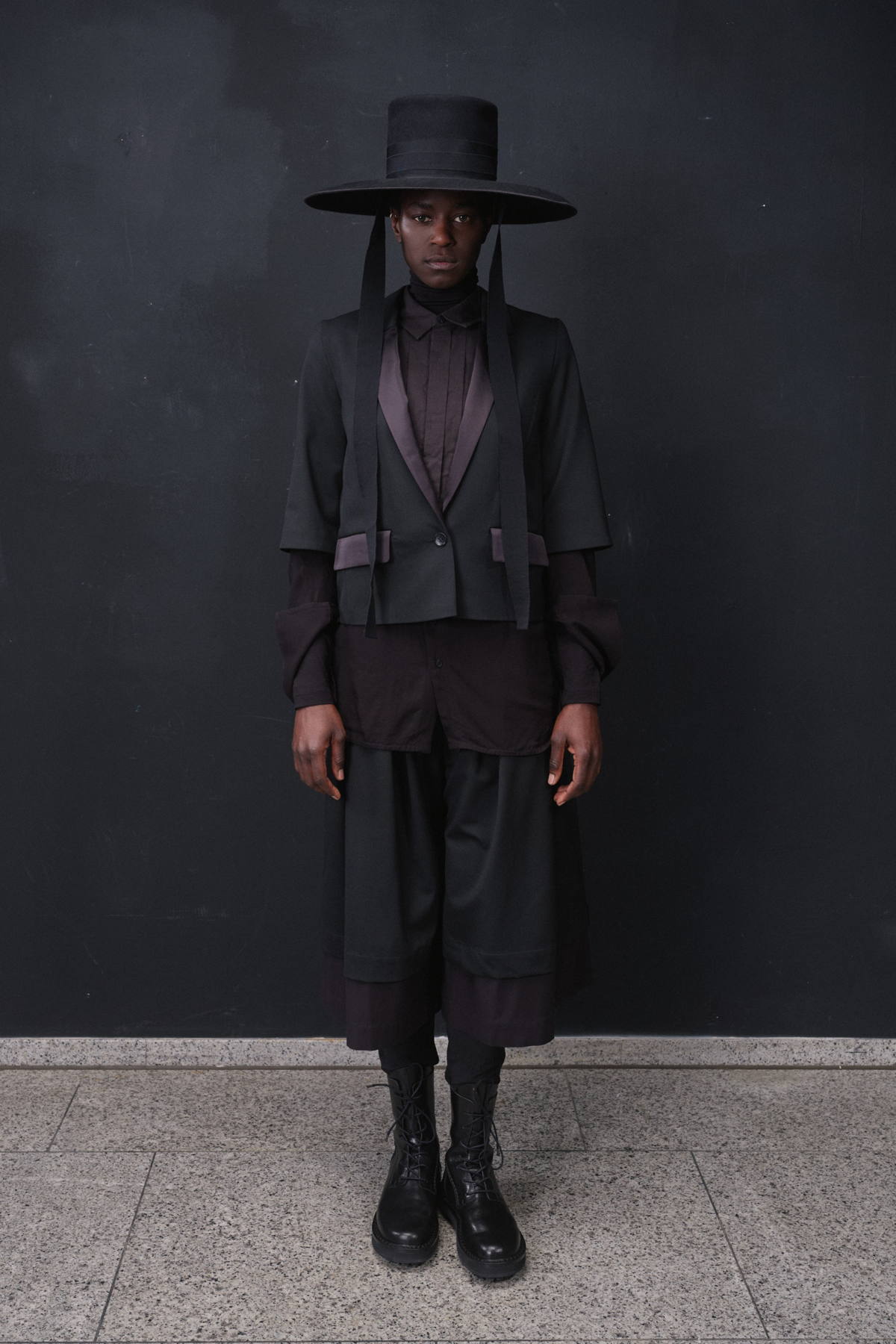
For me, clothing has always had two essential functions: protection and expression. But protection comes first. Without feeling protected, expression becomes performative or uncomfortable. That understanding comes from my own journey. It took me many years to develop my own visual language, my own kind of protective armor.
When fashion becomes an experience, it has the potential to gently confront people with themselves. Not in an aggressive or intellectual way, but in a very physical, emotional one. I’ve observed this countless times in my store. Many people hesitate to enter, to try something on. They often say it’s because of me or the brand, but I believe it’s more about the moment of self-confrontation. Trying on a garment means asking yourself: How do I want to feel? What do I need right now? Where do I want boundaries, and where do I want openness?
That moment of confrontation is important to me because it can be empowering. I’ve seen people put on a piece, look in the mirror, and suddenly stand differently: grow a little taller, breathe differently. The garment doesn’t change who they are, but it can support a shift in perception.
I don’t see this as teaching or guiding others. I’m part of the same process. Fashion, in that sense, becomes a shared space of exploration: a tool that allows both the wearer and the viewer to encounter themselves with a bit more honesty and courage.
“Order gives me stability. Disorder gives me momentum. The tension between the two is something I actively cultivate.”




You often place strong emphasis on site-specificity. How does the space in which your work is presented shape the narrative and emotional impact of a collection or performance?
Space is never neutral for me. Very often, I already have a specific location in mind before a collection or performance is fully formed: a place that can tell the story almost on its own, without much explanation. In those moments, space becomes a silent narrator. It carries atmosphere, history, tension, and emotion long before a single garment appears.
Of course, reality eventually enters the picture. Budgets, logistics, availability… not every ideal location is possible. That’s when compromise becomes part of the creative process. And when compromise is necessary, I believe you have to add a little more magic. You start working harder with light, sound, movement, or installation to transform the space into what it needs to become.
But places undeniably shape my work. I can walk into a space and my mind immediately starts to play. I don’t just see the room. I see the finished presentation, the movement of bodies, the emotional rhythm. Sometimes it even works the other way around: a space becomes the starting point of an entire collection.
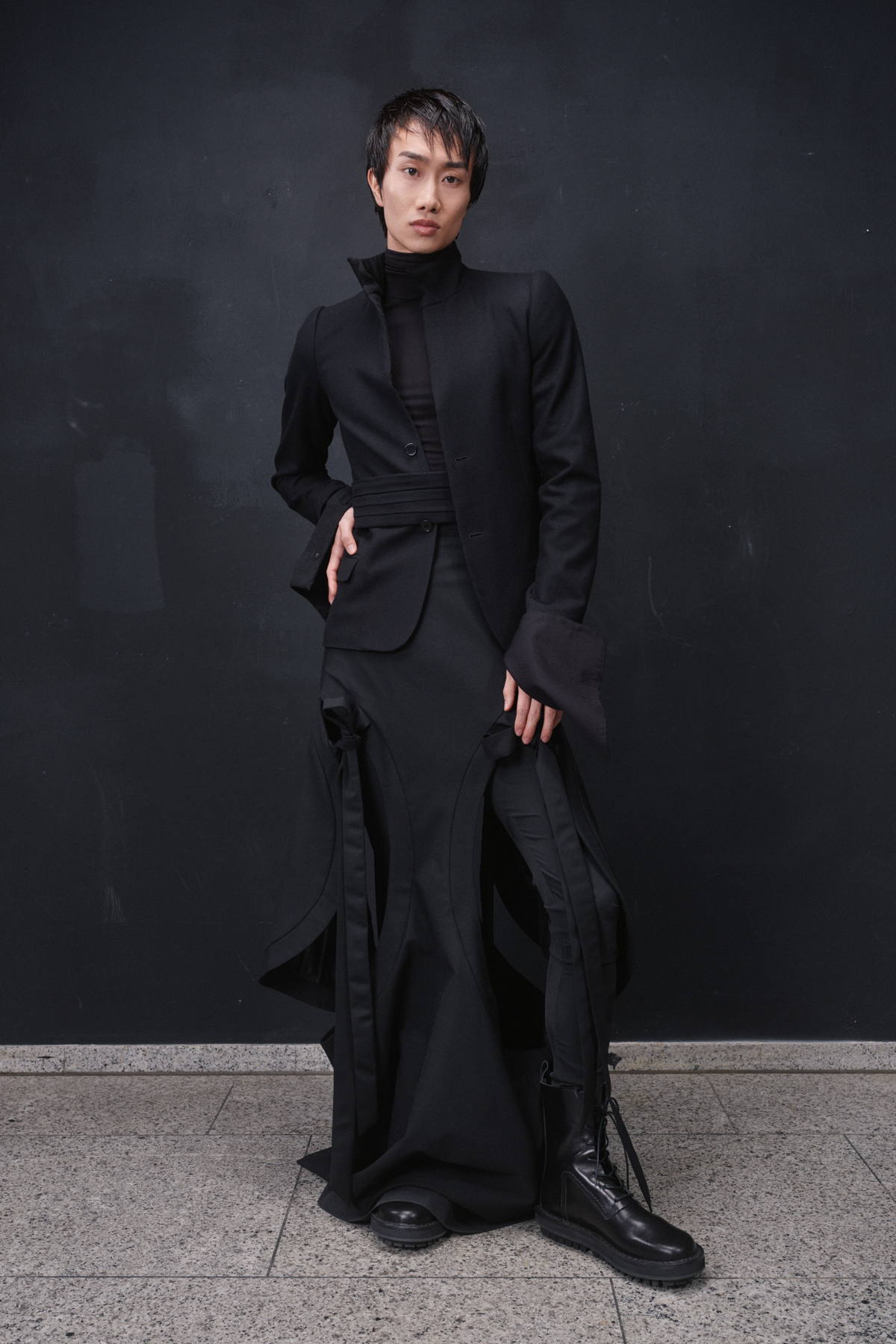
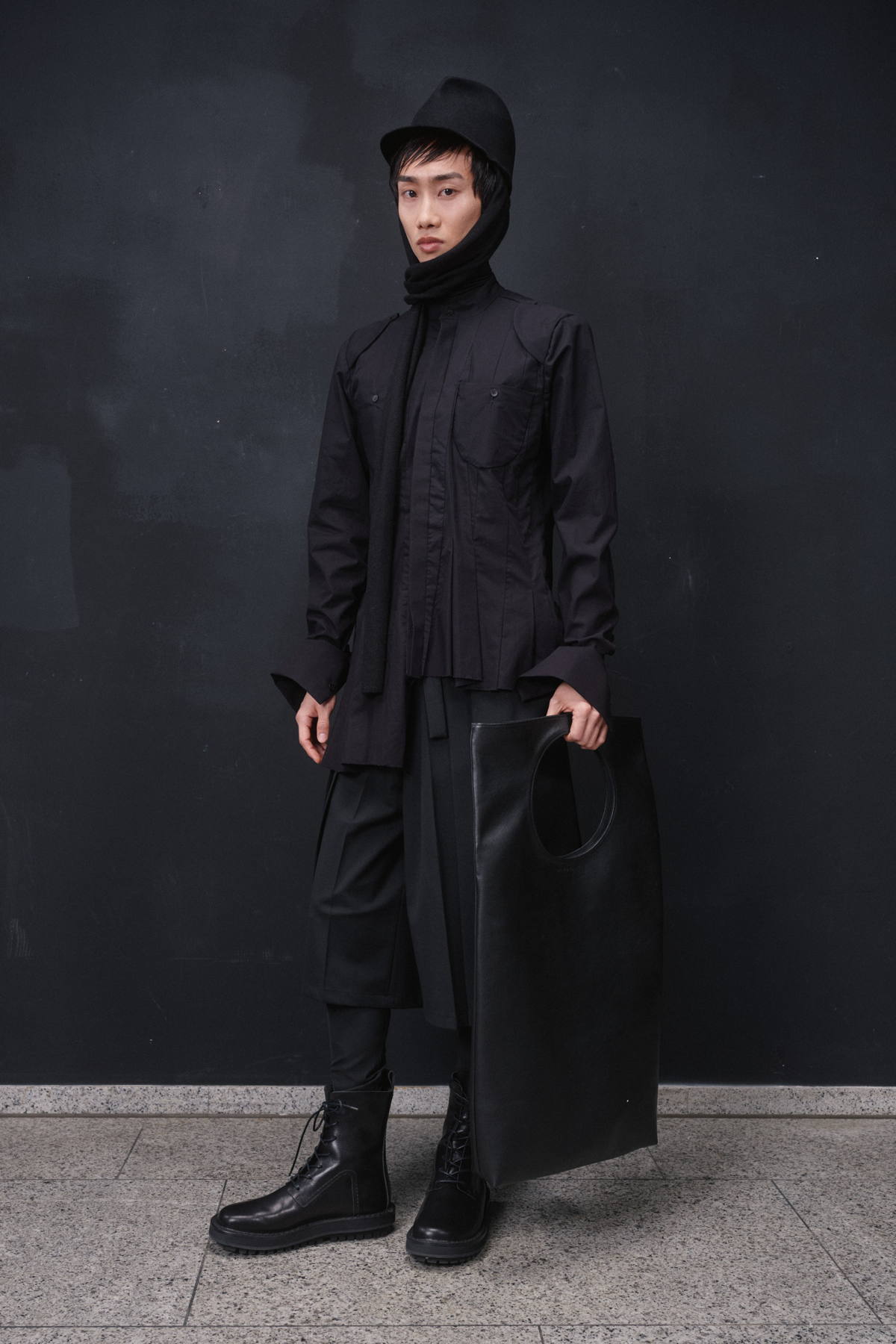
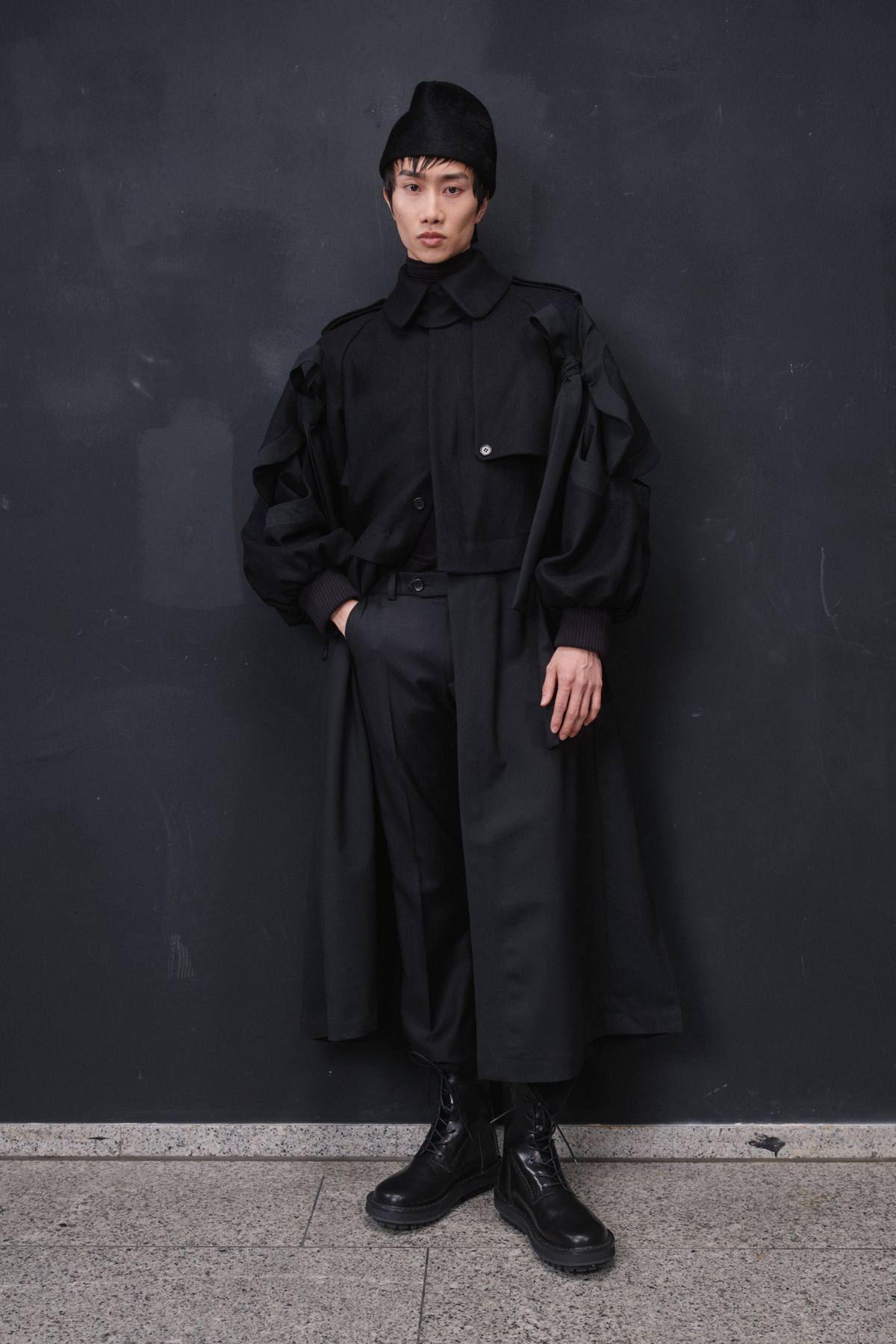
That was the case with Zero Point. The collection began during a quiet moment spent in front of my favorite installation at Dark Matter in Berlin. Sitting there, surrounded by movement, stillness, and energy, something clicked. The atmosphere of that space—its circles, its pulse, its sense of suspension—planted the first seed. From there, the narrative unfolded.
For me, site-specificity is not about staging fashion in a spectacular setting. It’s about allowing space to amplify emotion, to open imagination, and to create a dialogue between body, garment, and environment. When that works, the experience becomes engrained as a memory.
Beyond fashion, you work installatively and sculpturally. What draws you to these formats, and how do they extend the ideas explored in your garments?
Building my own brand for more than 22 years has taken —and still takes— an enormous amount of energy. Fashion isn’t just my work; it occupies most of my time, my thoughts, even my spare moments. I don’t really have hobbies in the classical sense.
Working installatively and sculpturally functions almost like an escape room for me. These are the moments when I’m allowed to step aside, to complain about fashion if I need to, and to return to the playground. The pressure shifts. Suddenly, I’m not thinking about production costs, timelines, or sales. I’m simply playing, experimenting, and following intuition.
What fascinates me is how quickly my mindset changes. There’s a very childlike excitement that comes with these projects, a lightness that gives me new energy and strength. That energy doesn’t disappear; I carry it back into my fashion work. And it works the other way around as well. Once I finish a more artistic project, I find myself longing to return to garments, to the body, to tailoring and craft. The two worlds nourish each other. Installations allow ideas to expand freely, while clothing brings them back into a physical, wearable reality.
For me, these formats are a way of keeping my relationship with fashion alive, curious, and emotionally honest.
Textile, structure, and materiality recur in both your art and fashion. How do these shared elements create a larger conceptual framework beyond aesthetics?
For me, textile, structure, and materiality are not abstract concepts, they are tools I’ve worked with every day for more than 22 years. What connects my fashion and my artistic work is this long, hands-on experience within the fashion industry: understanding how materials behave, how they carry weight, tension, softness, resistance.
Because of that, my installations and sculptural works don’t start from theory, but from knowledge gained through practice. Every piece of fabric, every structure already carries a history of decisions, mistakes, and learning processes. That gives the work a conceptual depth that goes beyond pure aesthetics.
At the same time, these shared elements allow me to keep learning. When I use textile in an artistic context, I see it differently than on the body. When I return to garments, that perspective stays with me. In this way, fashion and art become one continuous field of research: grounded in experience, but always evolving.


Black is central to your visual language and appears consistently. What potential does black still hold for you as a space of exploration?
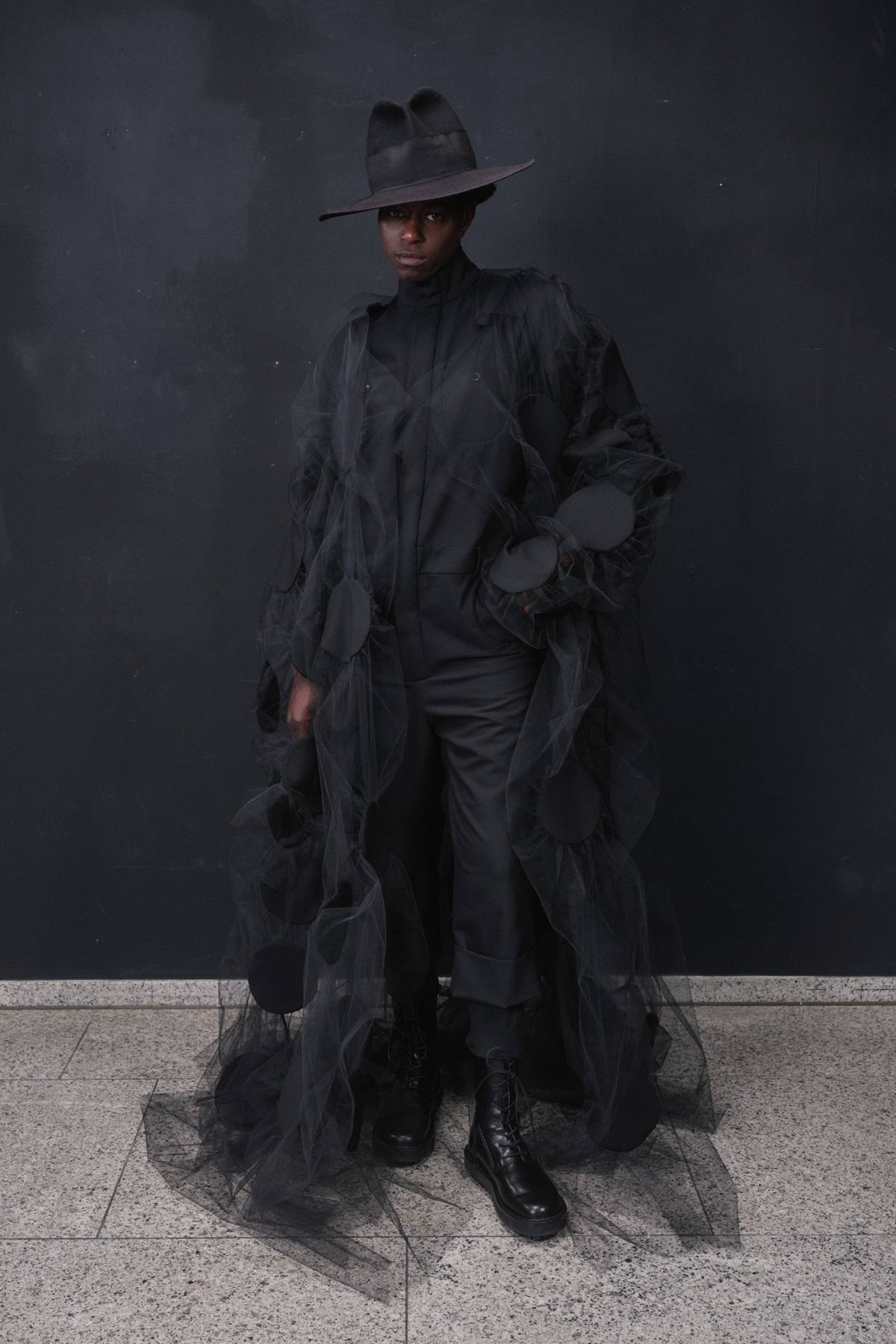
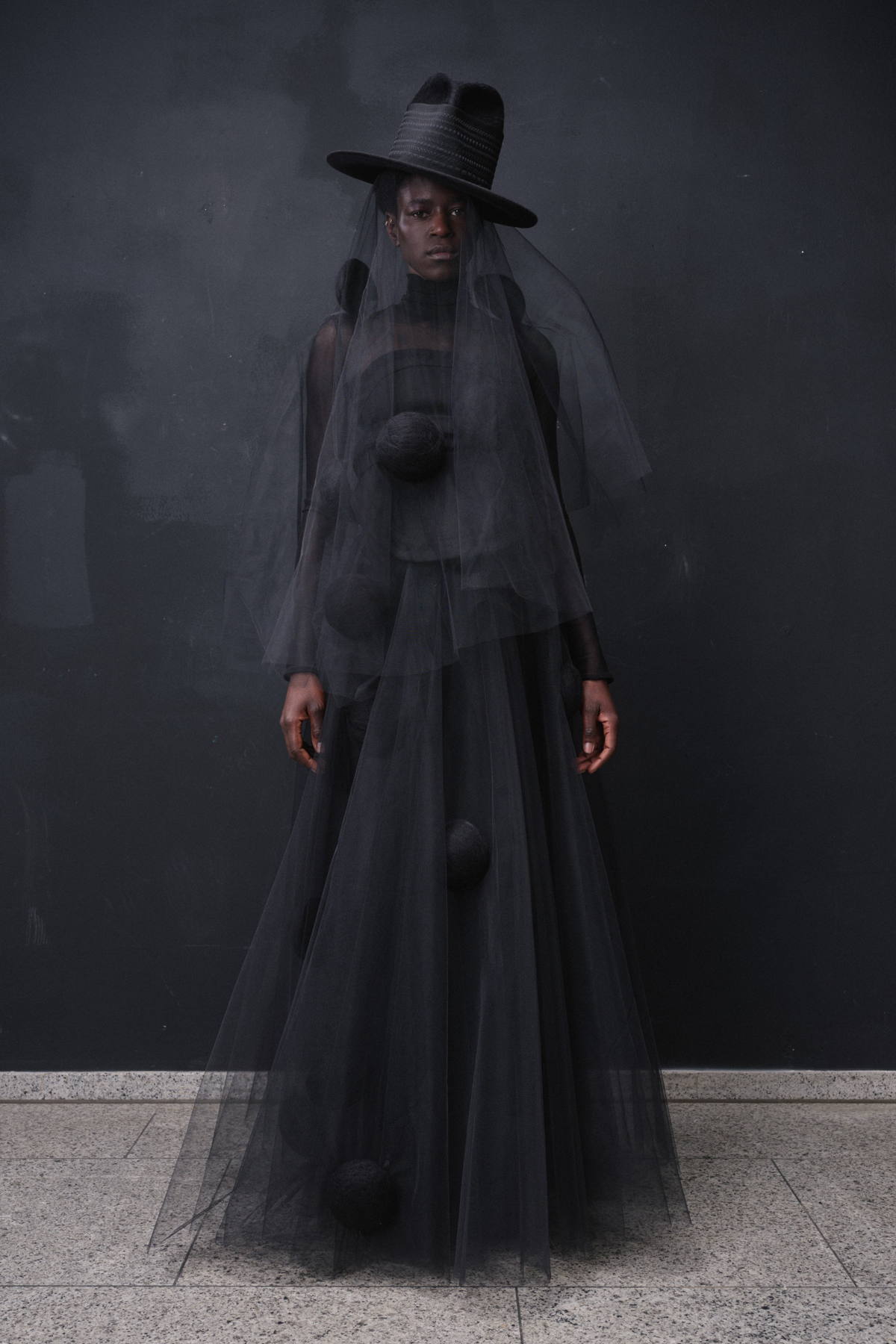
Black is still my zero point. It’s the surface from which everything can begin. For me, black is never absence. It’s density, totality, and possibility. Because color is removed, every other element becomes sharper: structure, texture, proportion, movement. What continues to fascinate me is that black never exhausts itself. The more I work with it, the more I discover. A new cut, a new material, a different transparency can completely shift its character. Black is stable, but never static.
As a space of exploration, black allows me to go deeper rather than broader. Instead of adding, I refine. Instead of multiplying, I intensify. It gives me the freedom to experiment –emotionally, aesthetically, and conceptually– without losing clarity.
I don’t see black as a signature I need to defend. I see it as an open field I can keep returning to, again and again, and still find something unexpected waiting there.
Your work often plays with tension between order and disruption, control and release. How do these opposing forces shape your creative process?
My creative process is shaped by a constant ping-pong between order and disruption, control and release. I need a great deal of structure and discipline to work the way I do: without it, nothing would function. Deadlines, systems, repetition, precision: they create the framework that allows me to move freely at all.
At the same time, creativity only truly happens when I allow chaos to enter. When I let go. When I jump into cold water without knowing exactly how deep it is. “Jumping so high you hit your head on the ceiling; then landing hard enough to feel it in your feet.” That’s painfully accurate for my work-process.
I often overshoot intuitively, sometimes naively. I push ideas too far, collide with limits, recalibrate, and start again. Headaches from aiming too high, sore feet from landing too fast… this rhythm is part of my energy, part of how I learn and move forward. Order gives me stability. Disorder gives me momentum. The tension between the two is something I actively cultivate. That friction is where my work comes alive.
Rather than dressing people up, your work aims to empower them. How do you translate abstract ideas like autonomy, individuality, and strength into physical form?
I don’t start from abstract concepts like empowerment, autonomy, or strength. They were never a strategy or a predefined goal. What people perceive today as the outcome of my work is the result of many years of practice, repetition, and personal evolution.
These qualities emerged intuitively over time, through listening to my own needs, through working closely with bodies, and through observing how people move, feel, and behave when they wear certain garments. The process was never theoretical. It was physical, emotional, and often unconscious.
Strength, for example, comes from construction, from weight, from how a garment holds the body without restricting it. Autonomy lies in flexibility: in pieces that allow the wearer to decide how much they want to reveal, protect, or emphasize. Individuality grows when clothing doesn’t impose a fixed identity but leaves room for interpretation.
What may read as empowerment today is, for me, simply the result of experience and intuition. The ideas didn’t come first, the work did. And only later did language catch up with what had already been happening for years.
Looking at your practice as a whole, how do you see the future of fashion evolving when it is approached as an interdisciplinary art form rather than a seasonal product?
I don’t believe we can turn back the clock. Fast fashion is here to stay. Why would people willingly give up having instant access to endless styles, trends, and inspiration? That reality won’t disappear.
What can exist alongside it is something else. A parallel system. A niche –but a meaningful one. When fashion is approached as an interdisciplinary art form, its value shifts. It’s no longer about speed or novelty, but about depth, intention, and care. The responsibility of creatives today is not to fight fast fashion head-on, but to keep offering alternatives. To educate gently. To show different rhythms. To make craftsmanship, materiality, and process tangible and emotionally accessible once more.
Fashion as art will never be for everyone. But there are people who collect clothing the way others collect art. They live with garments for decades, take care of them, allow them to age, disappear, and reappear. For those people, fashion isn’t seasonal. It’s part of a long relationship. I believe the future lies in accepting this coexistence. Not trying to convert the masses, but continuing to create spaces where fashion can slow down, deepen, and be felt… beyond trends, beyond seasons.


