Iris Van Herpen in Rotterdam: A Retrospective that Reimagines the Body and the Future
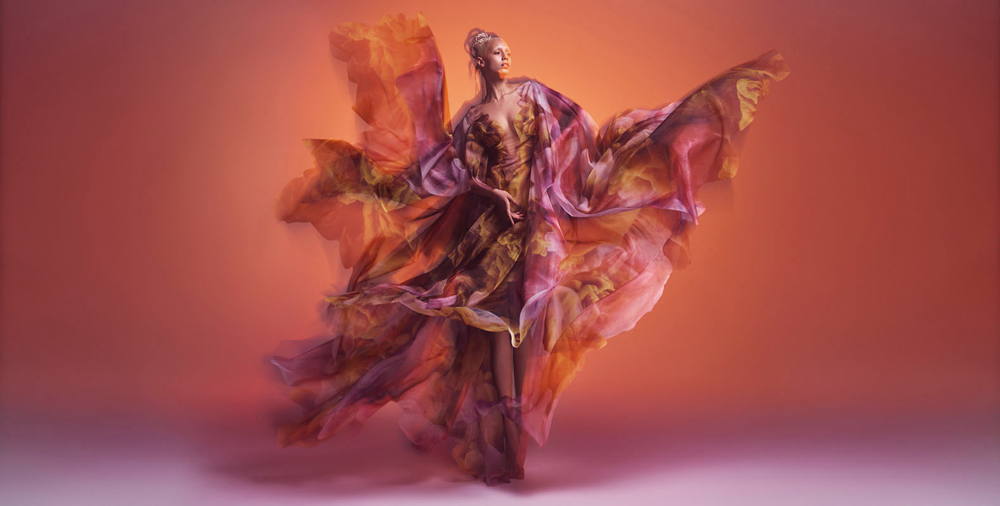
On 27 September, Kunsthal Rotterdam opened the doors of its largest exhibition space, HALL 2, to one of the most visionary designers of the 21st century: Iris Van Herpen. With “Sculpting the Senses”, the Dutch institution presents an expanded and renewed version of the major retrospective first shown at the Musée des Arts Décoratifs in Paris in 2023–2024. Conceived as a sensory journey, the exhibition invites visitors into Van Herpen’s universe, where fashion, science, visual arts, and technology intertwine until their boundaries dissolve.
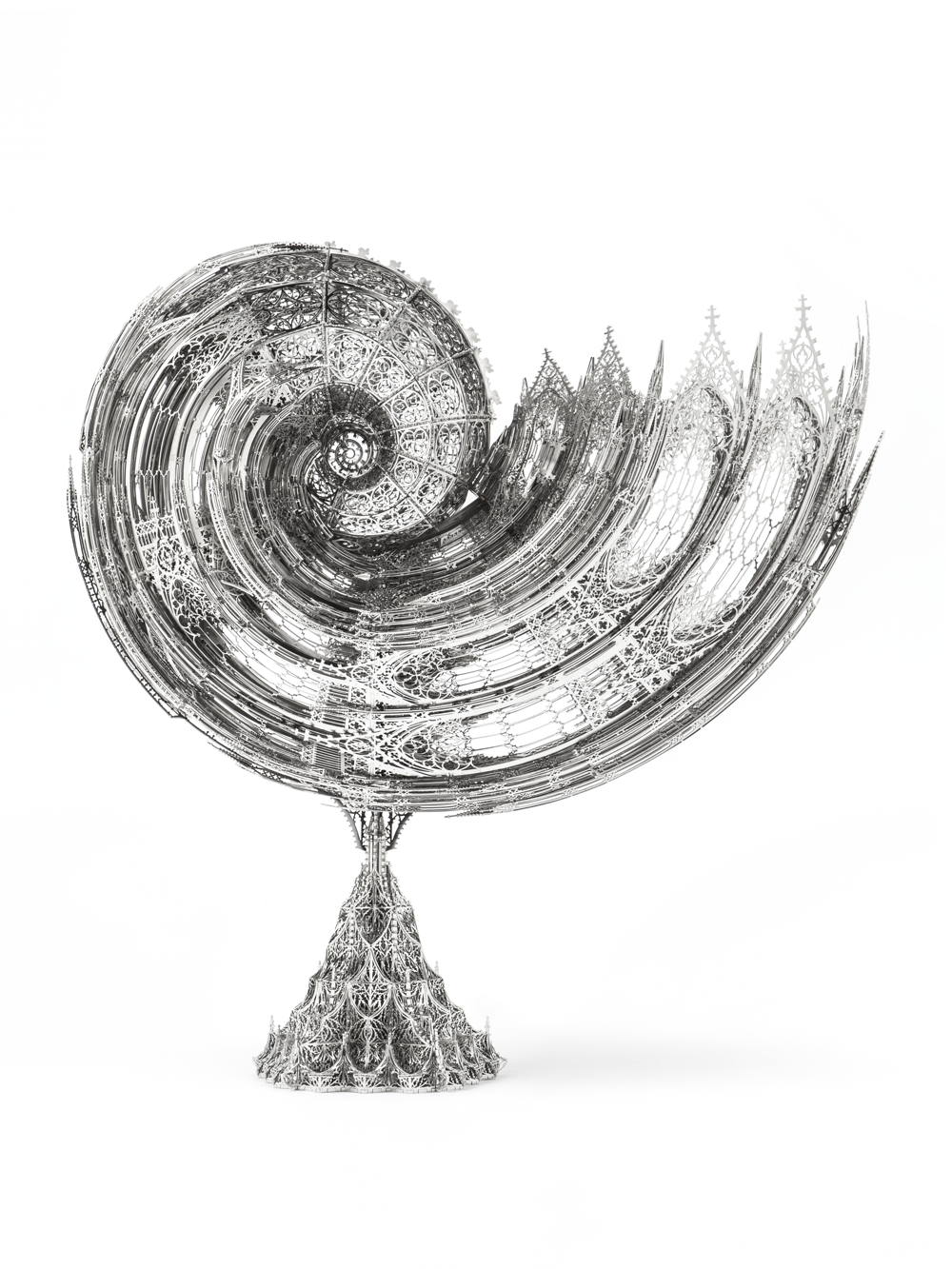
Few designers of her generation have reinvented the language of haute couture as radically as Van Herpen. Her practice, moving between meticulous craftsmanship and scientific-technological experimentation, continually expands the definition of what a body can be and how it can inhabit space. In Rotterdam, more than one hundred iconic creations from her most emblematic collections are presented alongside works by contemporary artists such as Philip Beesley, Collectif Mé, Kohei Nawa, Kate MccGwire, Damien Jalet, and Rogan Brown, as well as design objects by Neri Oxman, Ren Ri, and Ferruccio Laviani. Together, these dialogues form an aesthetic and conceptual constellation that reveals the full scope of her creative thinking.
The retrospective unfolds across nine thematic sections that act as gateways into her imagination. Topics that range from water and the origins of life to synaesthesia, mythological fear, and the hybrid futures of the human body. At Kunsthal Rotterdam, the scenography becomes even more immersive thanks to a spatial design adapted to the scale of the venue, accompanied by Salvador Breed’s multisensory soundtrack, which amplifies the exhibition’s atmospheric qualities. This is not simply an exhibition of dresses, but an experience of moving through environments, layers of materiality, hypothetical organisms, and structures that appear almost alive.
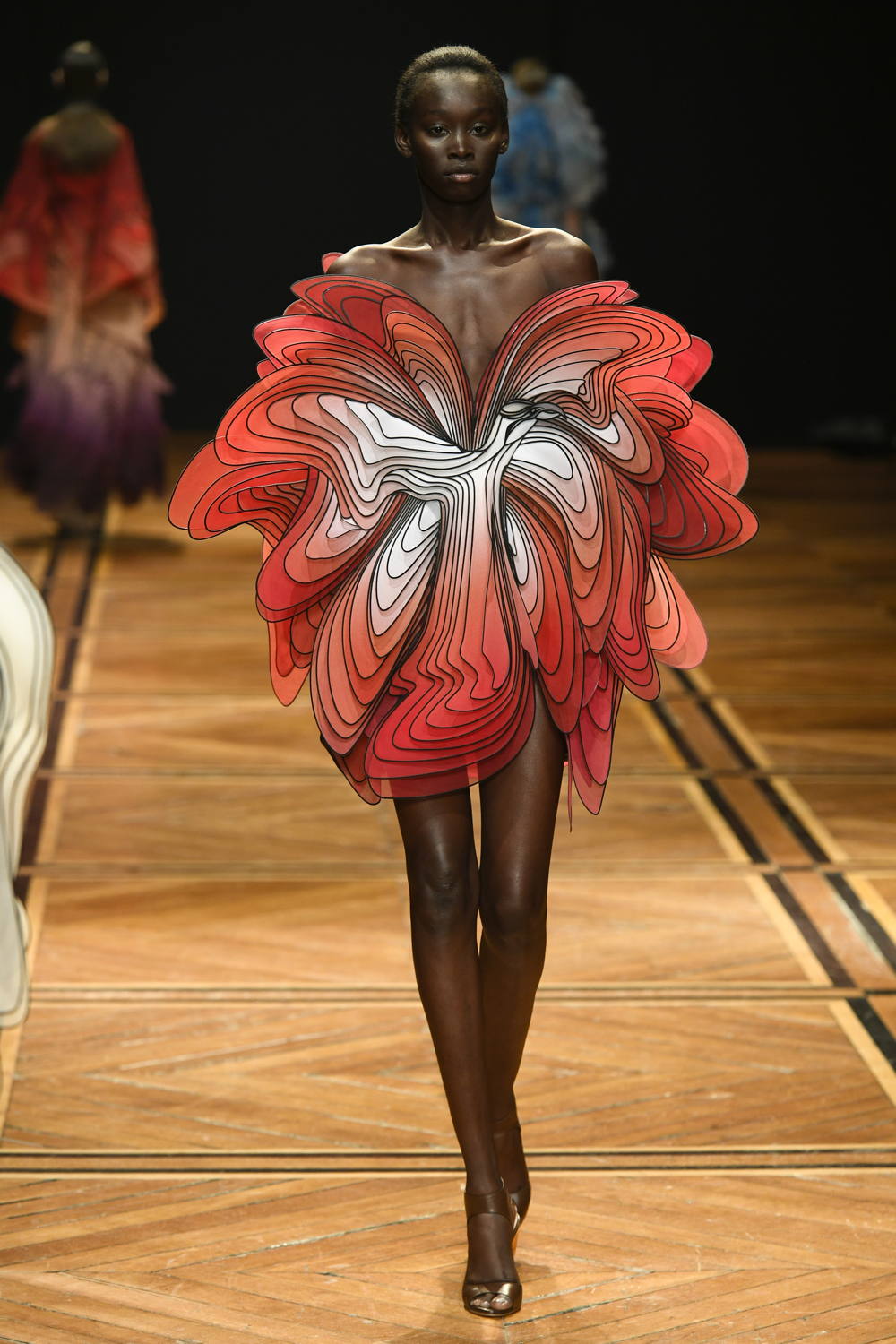
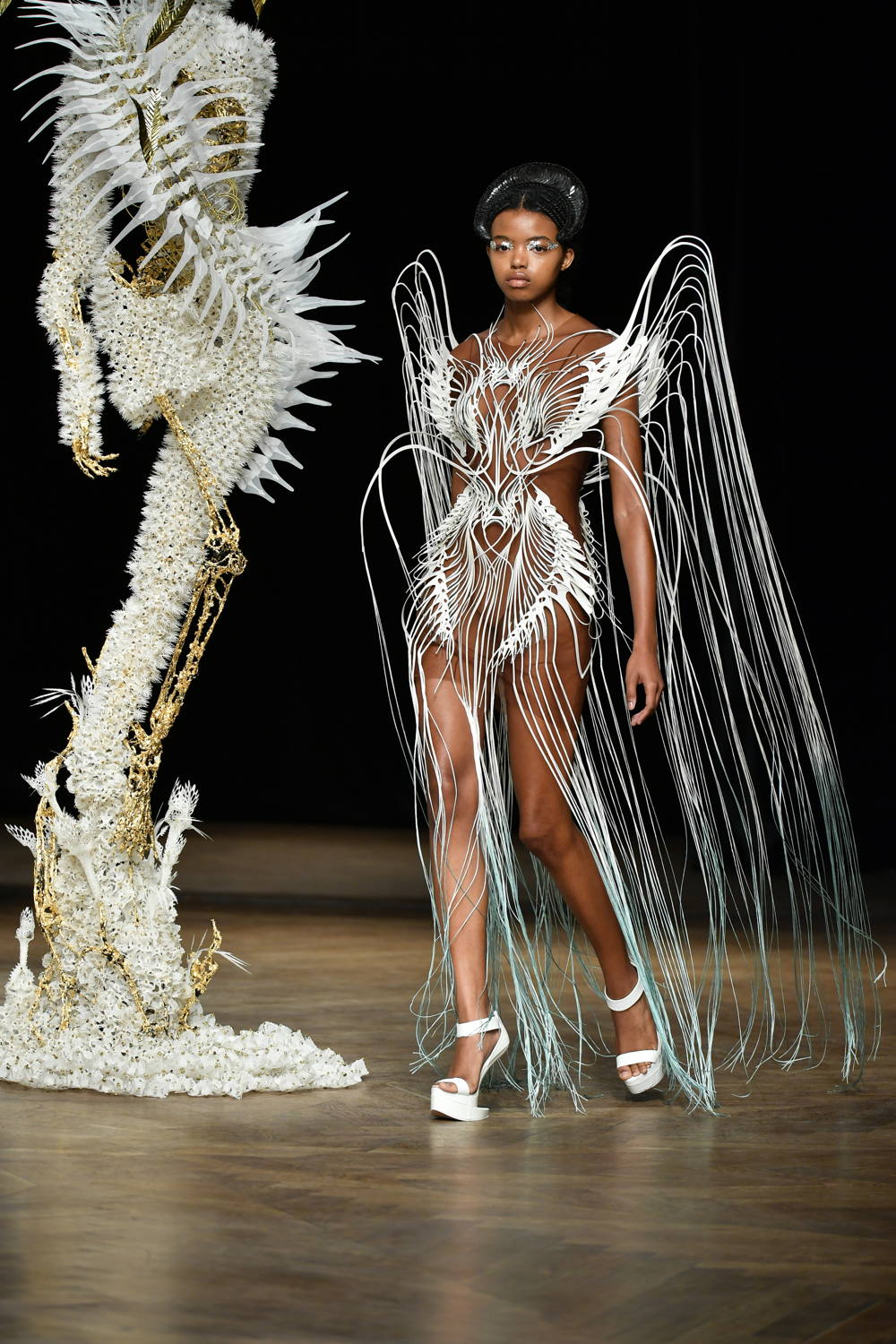


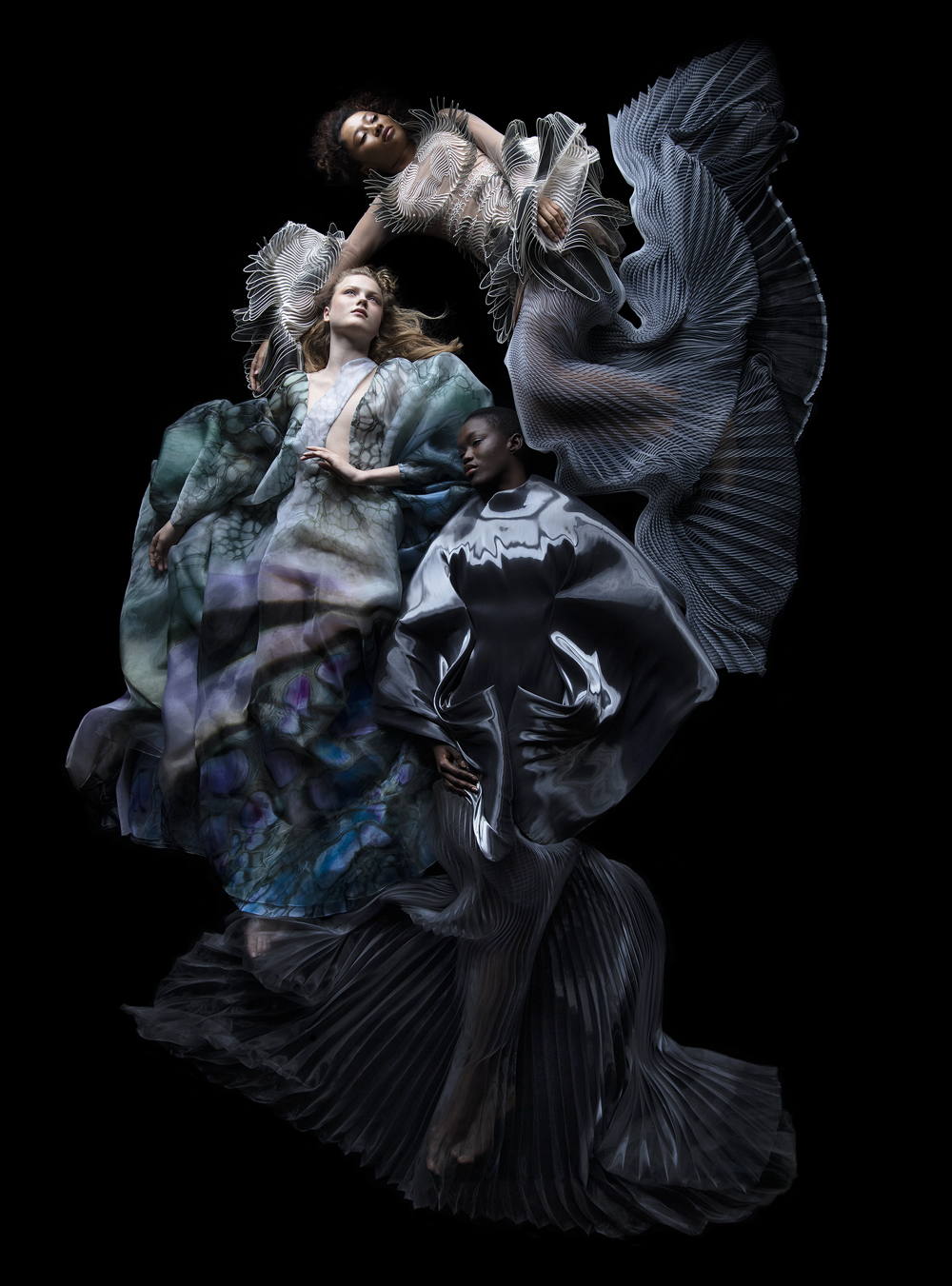
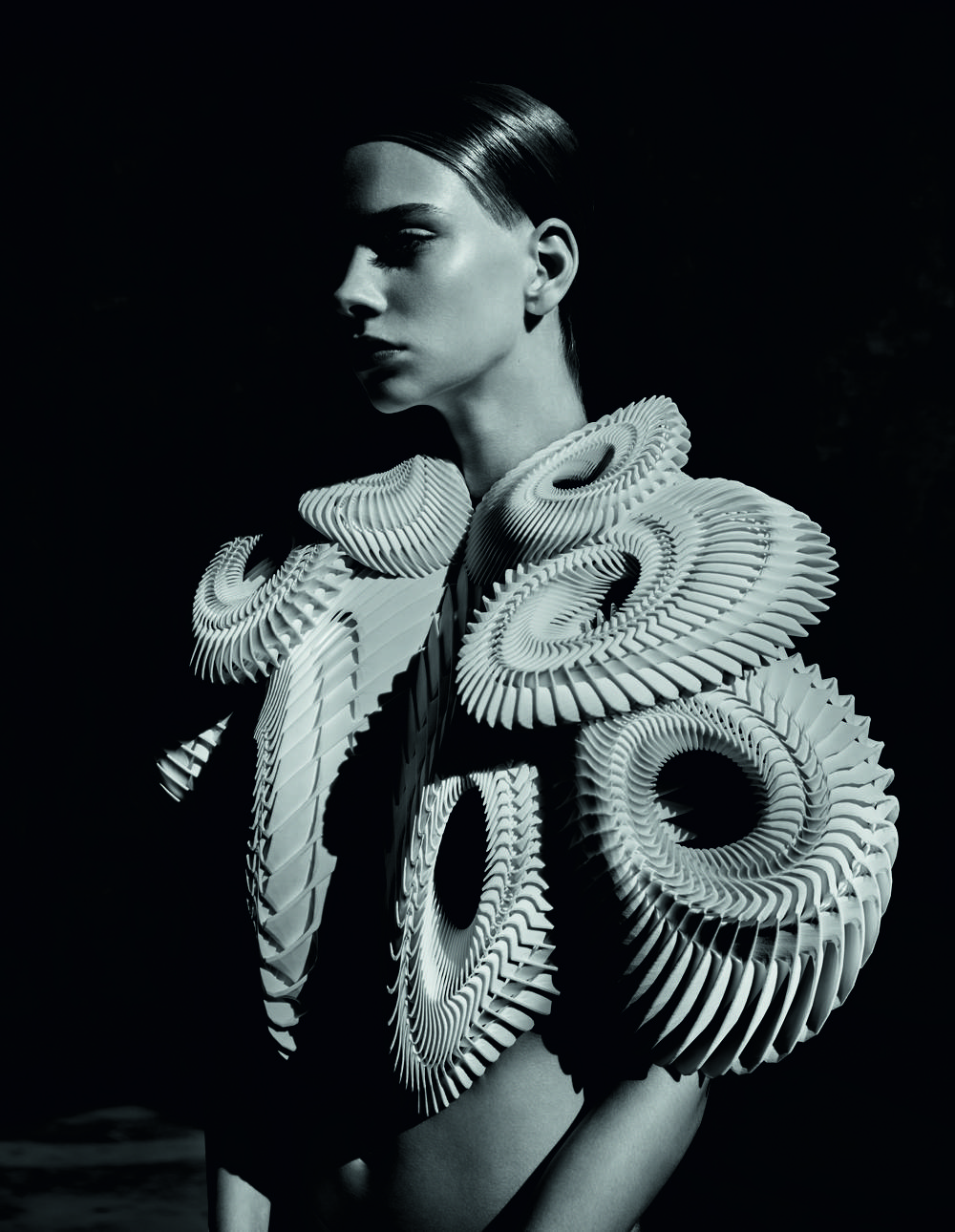
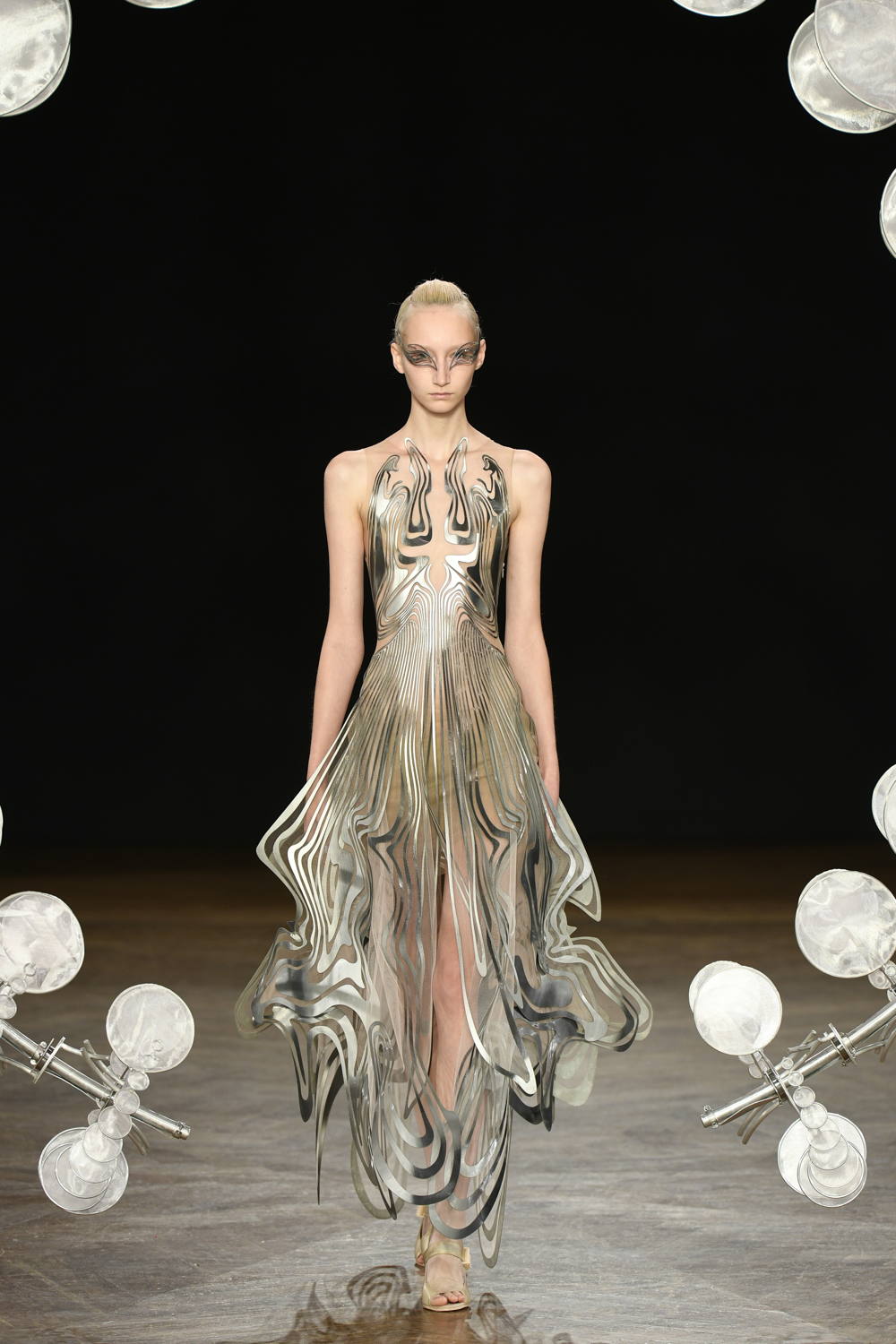
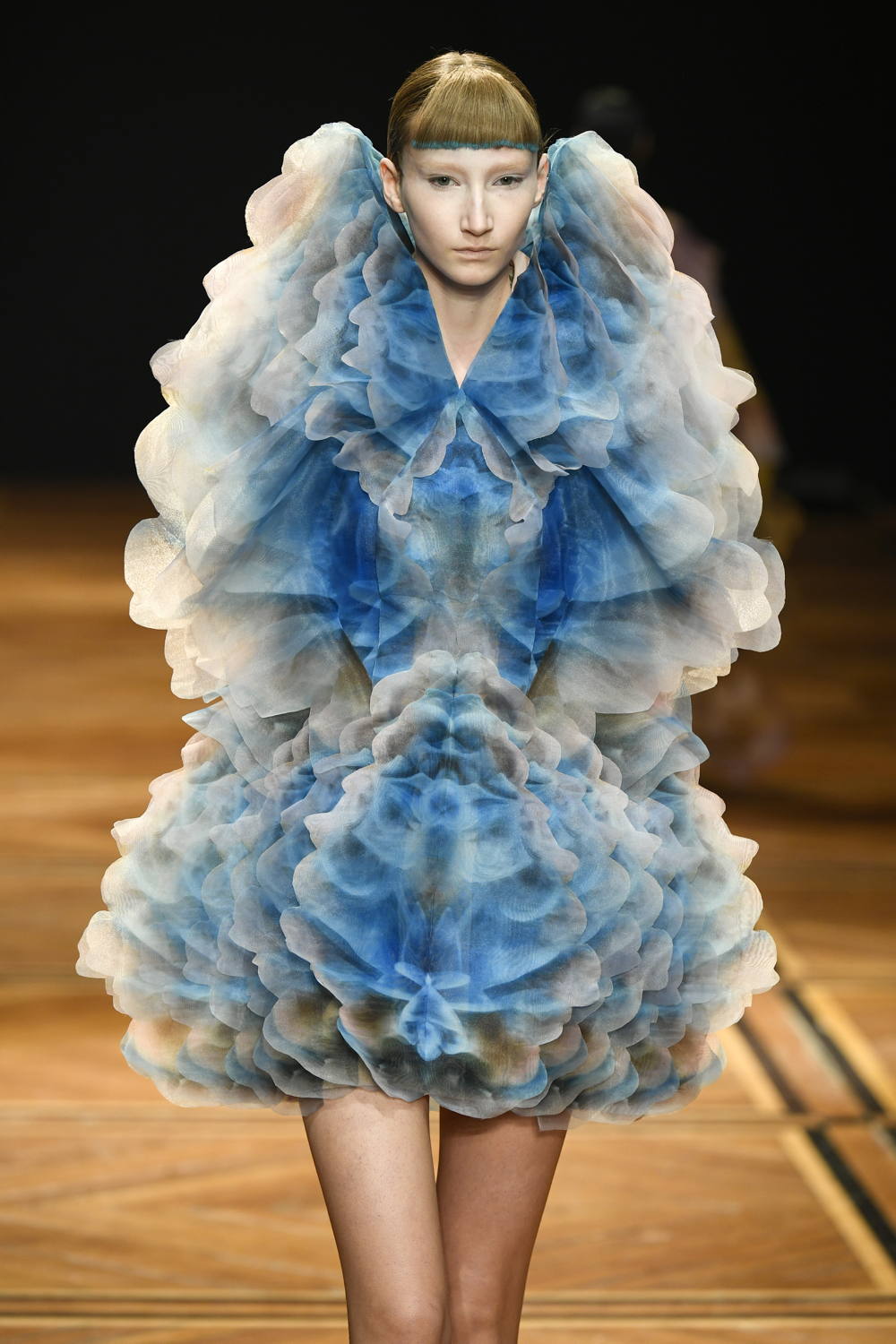
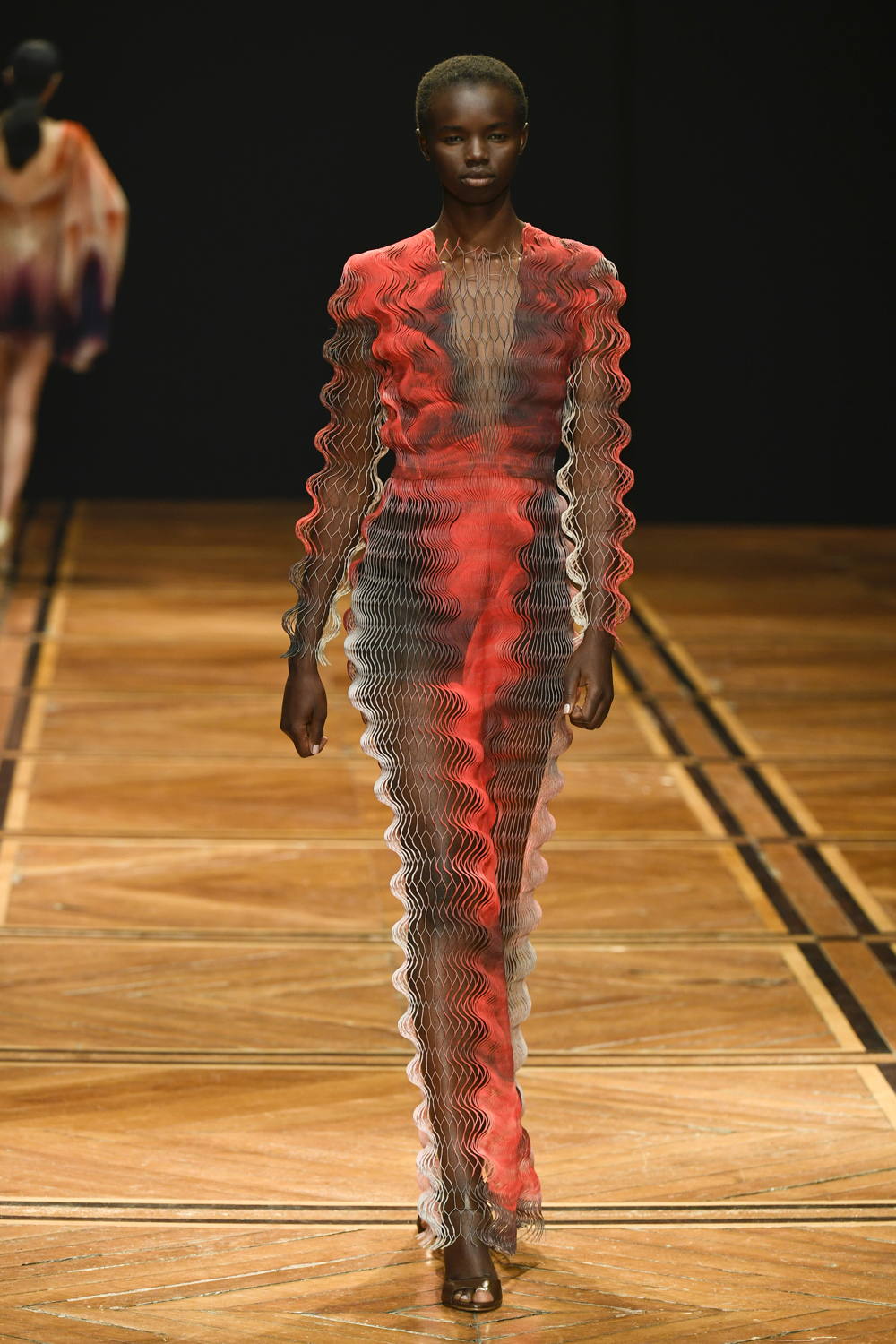
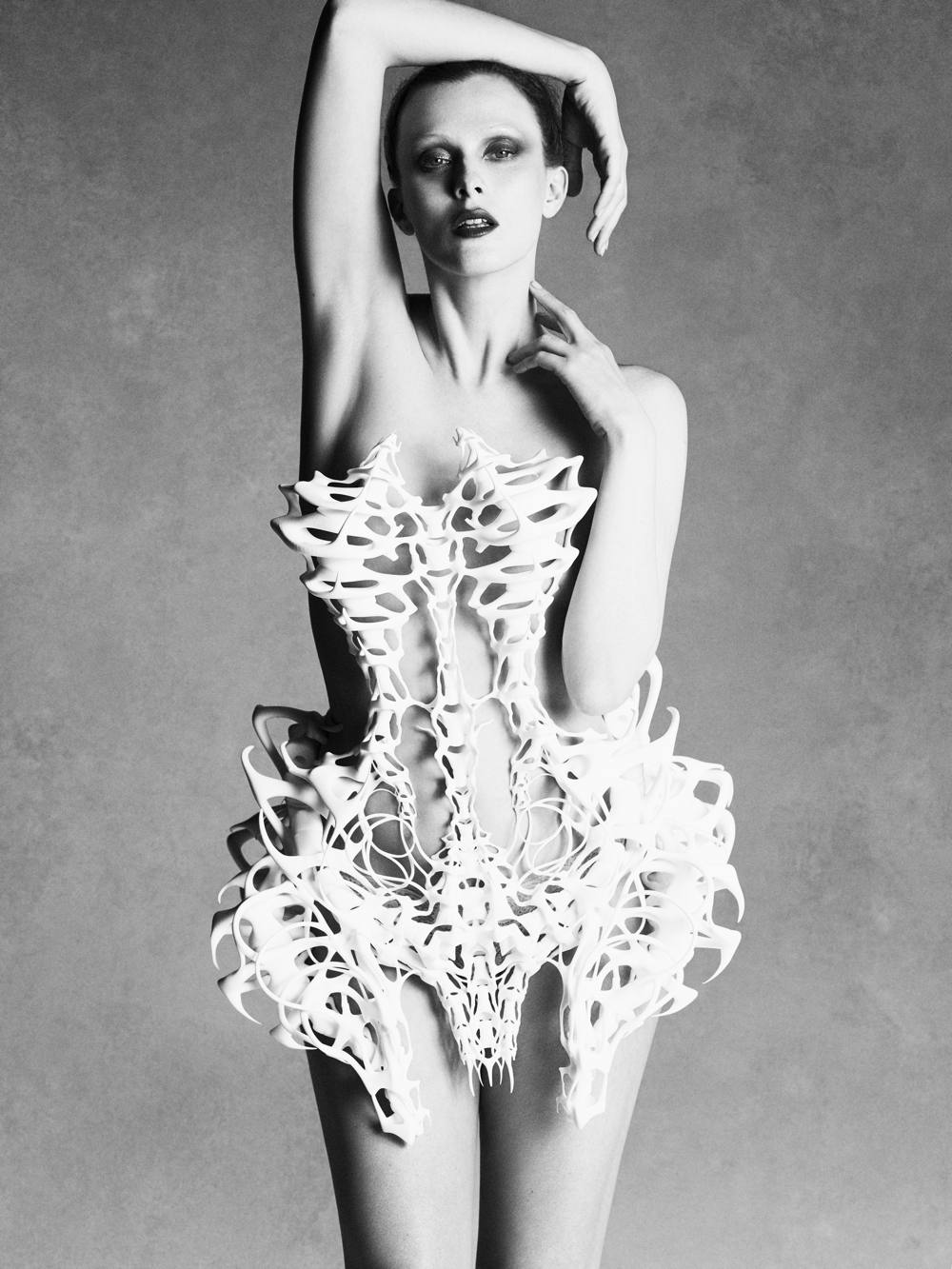
Nature remains a central axis of the exhibition. Van Herpen approaches water, air, marine ecosystems, and geological formations as languages capable of expanding the shape of the garment. The celebrated Crystallization top, her first 3D-printed piece, created in collaboration with architect Daniel Widrig, reappears here as a reminder of the moment when her work shifted toward the digital without abandoning the artisanal gesture. In collections such as Sensory Seas, translucent folds evoke deep-sea creatures and nervous systems; in Earth Rise, she works with recycled materials like Parley Ocean Plastic, combining formal innovation with ecological engagement.
Invisible worlds also become visible, mycelial networks, anatomical structures, fantastical skeletons, and Gothic architectures reimagined as porous bodies. Pieces such as the Henosis dress or the Cathedral dress reveal what usually remains hidden beneath the skin or beneath the earth. Van Herpen transforms these natural, architectural, and internal geometries into wearable surfaces that vibrate with movement.
The exhibition also dedicates a significant section to mythology, tracing references from Ovid to Japanese iconography and exploring fear and hybridisation, threads that connect to the early influence of Hieronymus Bosch on the designer’s imagination. The supernatural becomes fertile ground for questioning the boundary between the human and the non-human, the organic and the artificial.
Nature remains a central axis of the exhibition. Van Herpen approaches water, air, marine ecosystems, and geological formations as languages capable of expanding the shape of the garment.
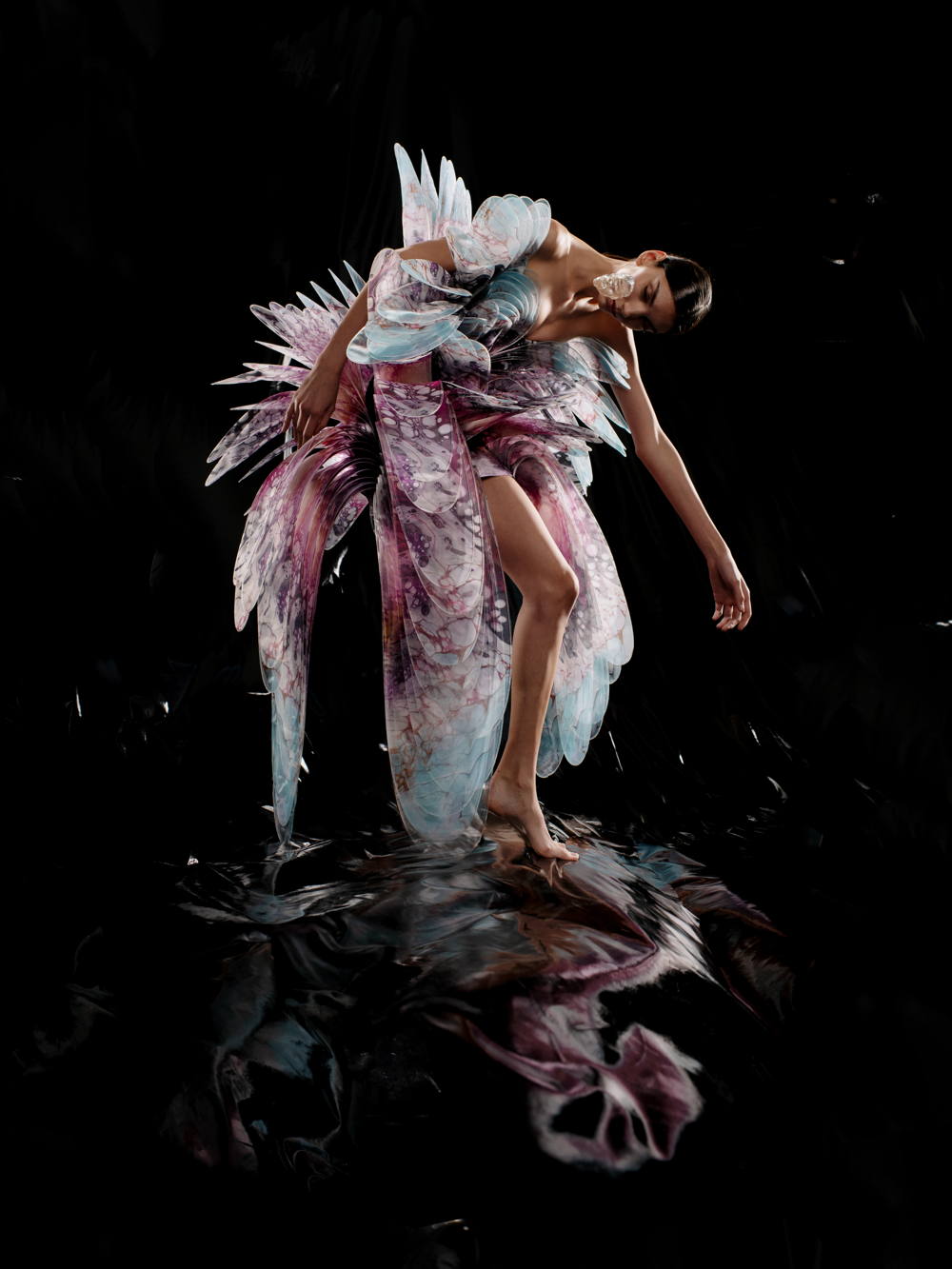
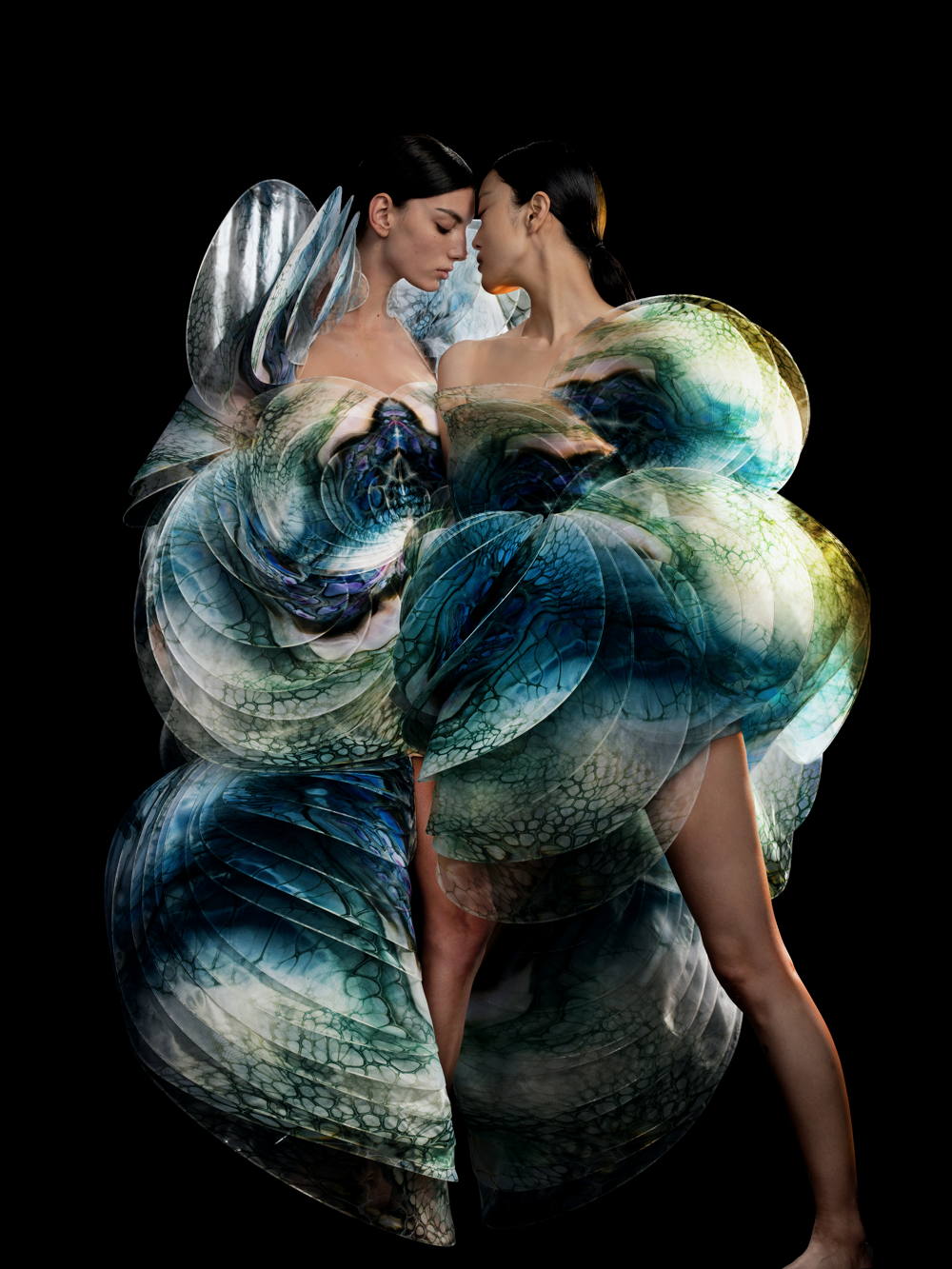
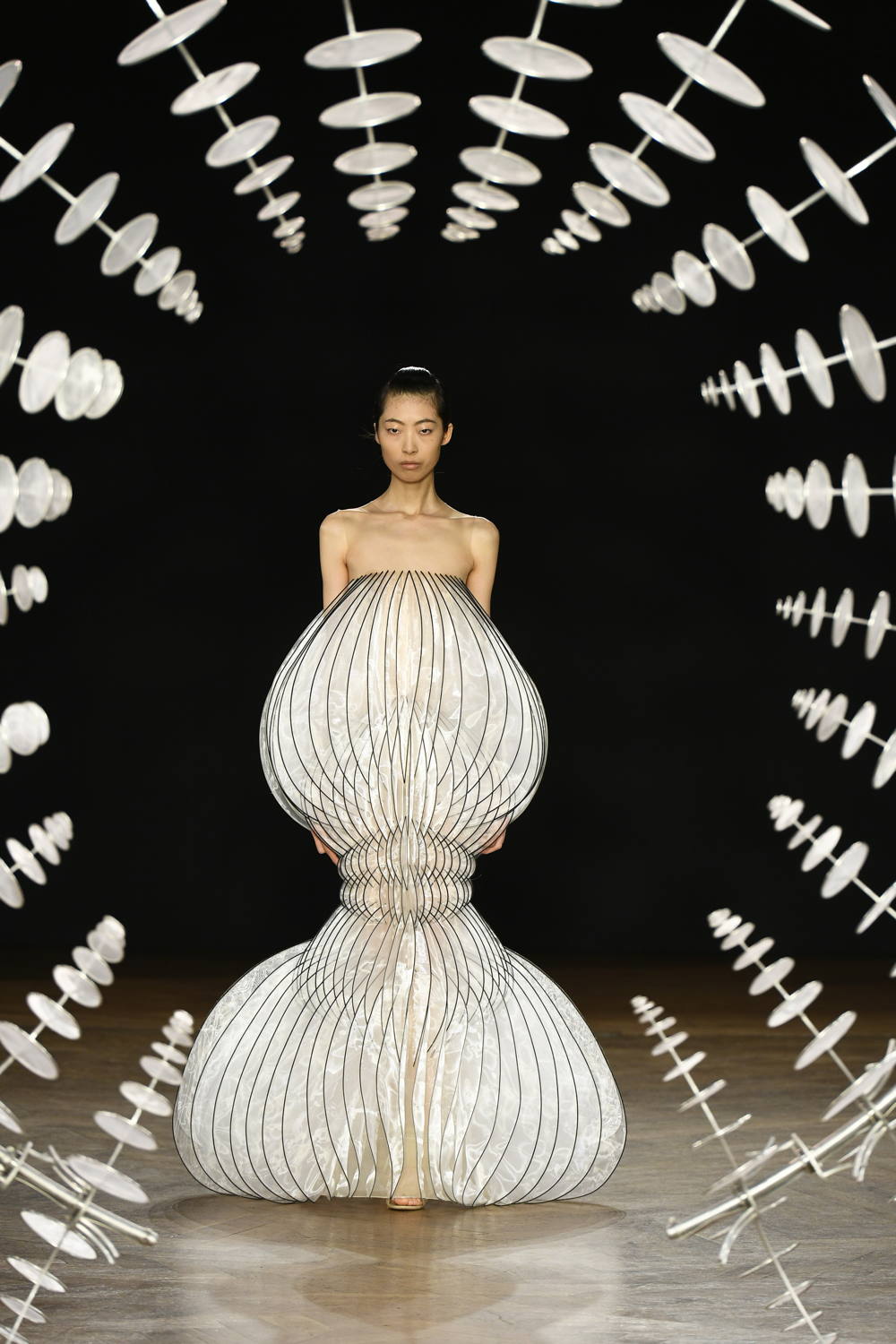
The exhibition culminates with a gaze toward the cosmos. Nebula imagery, Kim Keever’s dreamlike photographic worlds, and silhouettes suspended in space create an ethereal, almost astronomical finale. Here, the garments seem to float, stripped of the body, transformed into constellations. It is an invitation to think of fashion as a field for reflecting on existence, time, and perception.
Alongside the main displays, the exhibition includes a cabinet of curiosities and a replica of Van Herpen’s Amsterdam studio, complete with hundreds of samples, material experiments, and prototypes. This intimate look behind the scenes reveals a practice where technical precision and speculative imagination coexist in equilibrium.


Organised in collaboration with the Musée des Arts Décoratifs in Paris and Maison Iris van Herpen, and specially adapted for the Kunsthal, this exhibition is more than a retrospective, Sculpting the Senses is a manifesto. Van Herpen conceives fashion as an expanded form of knowledge, a place where physics, biology, dance, craftsmanship, and technology converge. In Rotterdam, this vision finds a space that amplifies its magnetic power.
Sculpting the Senses is on view at Kunsthal Rotterdam from 27 September 2025 to 1 March 2026, accompanied by an English-language catalogue that explores the exhibition and the trajectory of a designer who has turned experimentation into a way of life.
Van Herpen conceives fashion as an expanded form of knowledge, a place where physics, biology, dance, craftsmanship, and technology converge.